



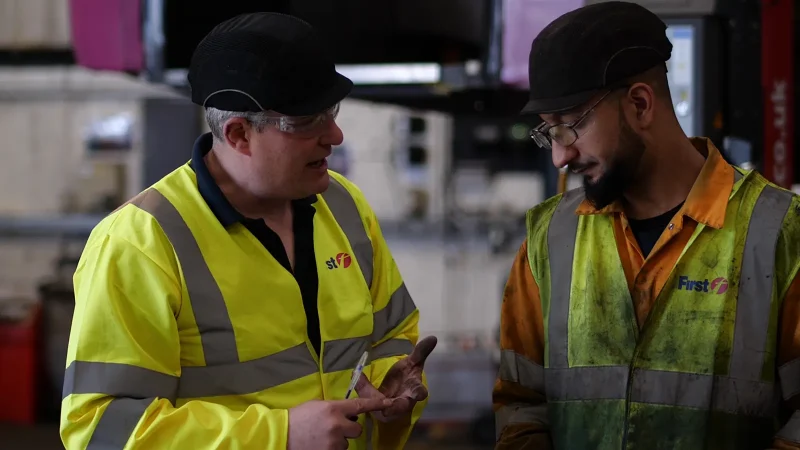
Every organisation we work with in transport, logistics and operations does safety training. Most do a great deal of it. The induction, the annual refresher, the toolbox talk, the e-learning module with the multiple-choice questions at the end. Much less of it is behavioural safety training, and the distinction matters more than it sounds.
And yet: 680,000 working people sustained an injury at work in Great Britain in 2024/25, and 40.1 million working days were lost to work-related illness and injury. The HSE puts the annual cost of injuries and ill health from current working conditions at £22.9 billion, on its most recent 2023/24 estimate.
Those numbers don’t describe a knowledge gap. Almost nobody is injured because they didn’t know the rule. They’re injured because, in that moment, something else mattered more.
The gap between knowing and doing
Ask any experienced operative why a shortcut gets taken and you’ll get an honest answer, if you’ve earned one. It saves eleven minutes. Everyone does it. The proper way is genuinely awkward with the equipment we’ve actually got. The last person who raised it got a reputation. We’re behind and the depot is short-staffed.
None of those are ignorance. They’re a rational response to a set of pressures that the training didn’t acknowledge and probably couldn’t. Which is why behavioural safety training that focuses on what people should know tends to produce compliant answers and unchanged behaviour.
The useful question isn’t “do they know the rule?” It’s “what makes the safe option the harder option here, and who has the power to change that?”
Safety is a communication problem more often than a technical one
This is the part that surprises people, and it’s why safety work sits so close to everything else we do.
When something goes wrong, the investigation frequently finds that somebody knew. Somebody had noticed the fault, the near miss, the pattern, the colleague who wasn’t coping. The information existed in the organisation. It just never travelled to anyone who could act on it.
It didn’t travel because raising it felt costly. Because the last three reports went into a system and nothing visibly happened. Because the supervisor was under pressure and everyone knew it. Because there’s a difference between a reporting process and a culture in which reporting feels normal, and most organisations have built the first and assumed the second.
That’s psychological safety, applied to physical safety . It isn’t a soft addition to a safety programme. On the evidence, it’s the mechanism by which the programme either works or doesn’t.
Blame is expensive
When an incident is treated primarily as a search for who was at fault, the organisation learns something quickly: don’t be the person holding the information.
Reporting drops. Near misses stop being logged. The data improves and the risk doesn’t. You’ve optimised the paperwork rather than the workplace, and you’ll find out the difference at the worst possible moment.
The alternative isn’t an absence of accountability — genuinely reckless behaviour still has consequences, and everyone knows the difference. It’s separating the question “what happened and why did it make sense to that person at the time?” from the question “who’s in trouble?” Ask them together and you’ll only ever get the second answer.
What behavioural safety training must actually change
Supervisors, not posters. The single strongest signal about what an organisation really values is what the person running the shift does when the schedule is tight. Safety leadership training for that group is worth more than any amount of campaign material.
Scenarios from your own operation. Generic e-learning gets generic engagement. Filmed scenarios drawn from real incidents in your own depots, with your own vehicles and your own language, get recognition — and recognition is where learning starts.
Visible response to what people report. Nothing increases reporting like evidence that reporting works. Close the loop publicly, even when the answer is “we looked at this and here’s why we’re not changing it.”
Making the safe way the easy way. Where behaviour keeps drifting in the same direction across many people, that’s rarely a character problem. It’s usually a design problem wearing a costume.
The 964,000
One last figure. Alongside the injuries, 964,000 workers in Great Britain reported work-related stress, depression or anxiety in 2024/25.
That belongs in this conversation, not in a separate wellbeing strategy. A tired, anxious, distracted person makes different decisions at height, at the wheel, or on a live site. Treating mental wellbeing as adjacent to safety rather than central to it is one of the more consequential filing errors an organisation can make.
Safety culture, in the end, is just what people do when the pressure is on and nobody’s watching. No behavioural safety training installs that directly. What it can do is build the conditions in which it becomes the obvious choice.
If your safety training is producing good scores and unchanged behaviour, let’s talk about a behavioural safety approach built around your operation. Explore our website, read our blog, and follow us on LinkedIn to learn more and discover ways to grow a more successful business.